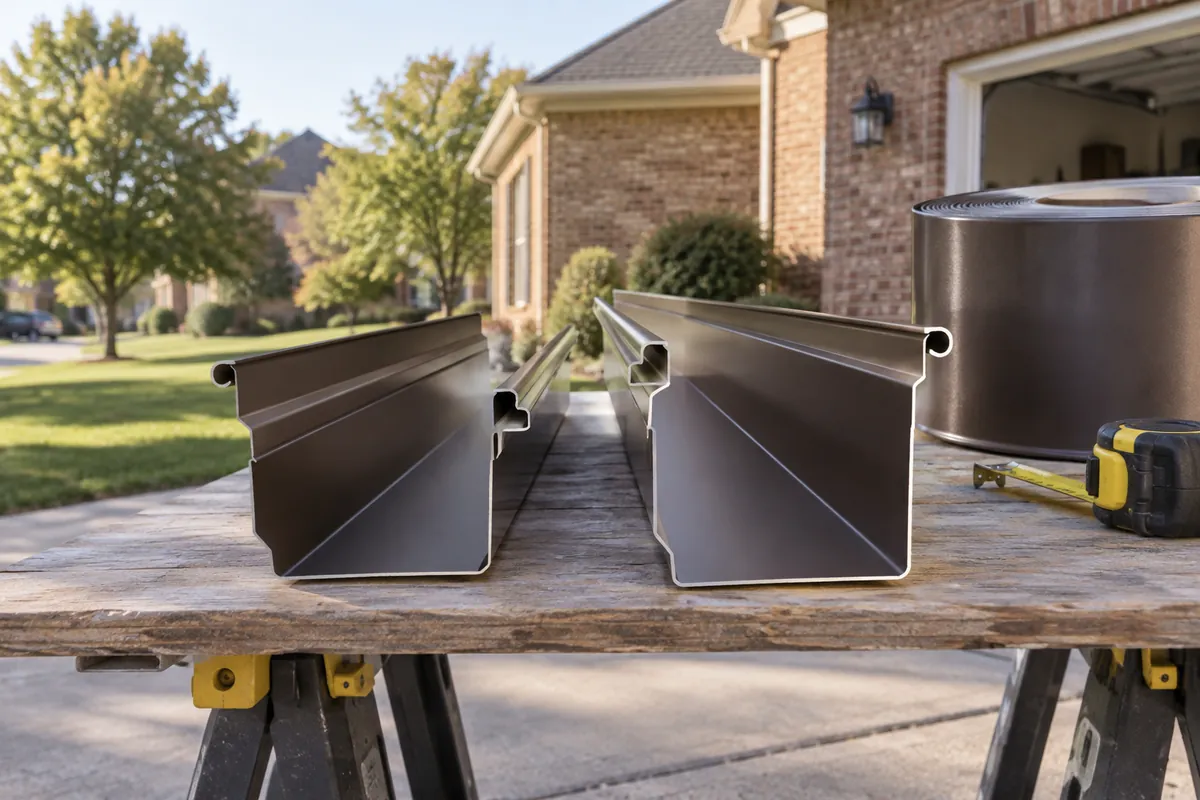
Seamless K-style and 6-inch systems sized for Kansas City rain, installed by vetted Johnson County contractors — with the local pricing most companies won't publish.
Calls answered Mon–Fri, 7 AM–9 PM.
Interstate 435 splits the city into two housing eras, and the gutters fail differently on each side of it.
Overland Park incorporated in 1960 with 28,000 residents and now has more than 200,000, which means the city was built in two long waves with very different ideas about roofs. The first wave filled the Shawnee Mission area north of 435 through the 1970s with single-story ranches, split-levels, and Cape Cods on quarter-acre lots, planted with the pin oaks and silver maples that were the fashionable street trees of the day. The second wave, from the 1980s onward, pushed south past 135th Street into what became the Blue Valley school district — two-story traditionals and colonials with steeper pitches, more gables, and rooflines that fold water into a handful of valleys. The median home in the city dates to 1984, which is really just the midpoint between those two cities.
In between sits a third band that gets less attention: the 1970s and '80s subdivisions of central Overland Park — Shannon Valley, Hawthorne, Nall Hills, Indian Creek — where two-story colonials and traditionals were built with the first generation of seamless aluminum. Those systems are now forty to fifty years old, and they fail in their own way: the hangers were spikes rather than screws, the miters were sealed with products that have long since dried out, and the runs have slowly lost the pitch they were hung with. A central-OP replacement usually needs no fascia work and no upsizing — just a modern system hung correctly on the same fascia.

Many of these homes are still hanging their original spike-and-ferrule gutters: ten-foot sectional lengths joined with slip connectors and nailed through the front lip into the fascia. The seams open at the miters, the spikes back out of fascia that has had seventy winters of wet-dry cycling, and a mature pin oak drops into all of it twice a year. Runs are short — 100 to 160 linear feet on a typical ranch — so a full seamless replacement is one of the more affordable exterior jobs on these homes, and a few feet of fascia repair is usually part of it.
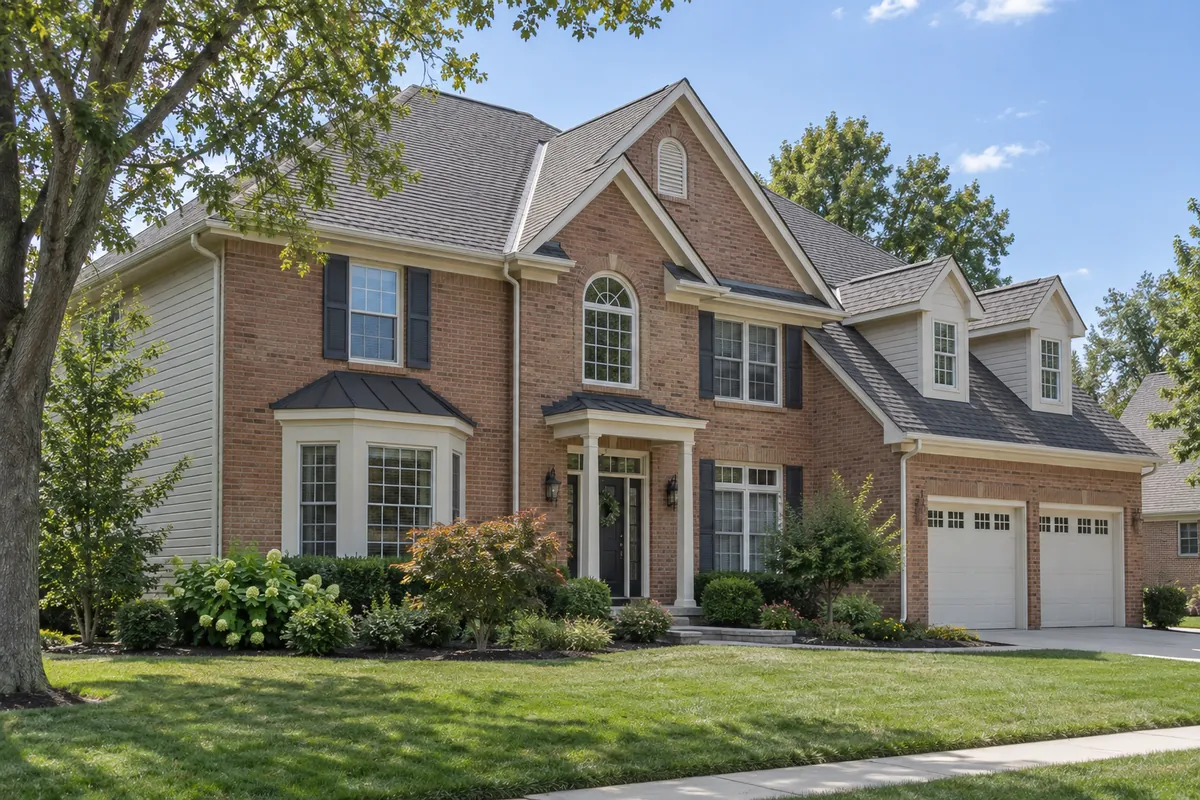
From Deer Creek and Nottingham Forest down through Lionsgate, Wilshire Farms, and Terrybrook Farms, the housing is 1980s-to-2020s two-story traditional with complex rooflines. Three or four roof planes drain to one inside corner, and rooflines run 180 to 280 linear feet. Most of these homes were built with 5-inch gutters sized for a ranch, which is why so many of them overflow at the same corner every May. This is 6-inch territory, and the original systems are now reaching the age where hangers pull and seams open.
Most replacement calls in Johnson County start with one of four triggers: seams that leak no matter how often they're resealed, a run that has pulled away from the fascia and now pitches the wrong direction, rust-through on an older galvanized steel system, or a spring hail storm that dimpled every south-facing foot of aluminum. One of those on a ten-year-old system is a repair. Two or three of them on a system twenty years old is a replacement, and the money spent chasing leaks in between is usually money lost.
Seamless aluminum is the Kansas City standard for good reason. A contractor brings a roll-forming machine to the driveway and extrudes each run to the exact length of the fascia, so the only joints on the house are at the corners and the downspout outlets. Aluminum doesn't rust, takes a baked-on finish in three dozen colors that match the trim on nearly any Overland Park home, and is light enough to hang on fascia that wouldn't hold steel. The material is not where installations go wrong.
Where they go wrong is in the three things a homeowner can't see from the driveway. The first is fascia condition: on a north-side ranch the wood behind the old gutter is often soft for a foot on either side of every spike, and a new gutter hung on rotten fascia will be on the ground in two winters. A qualified contractor will probe the fascia before hanging anything and quote the repair in writing. The second is hanger spacing. Hidden hangers screwed through the back of the gutter into the fascia should sit every 24 inches, and every 18 on runs that carry ice, because a 40-foot gutter full of slush weighs more than most people expect. Budget installs stretch that to 36 inches and the run sags within a few seasons. The third is pitch: about a quarter inch of fall for every ten feet toward the outlet, set with a level rather than by eye, so that water leaves the gutter instead of standing in it and breeding mosquitoes through a Kansas summer.
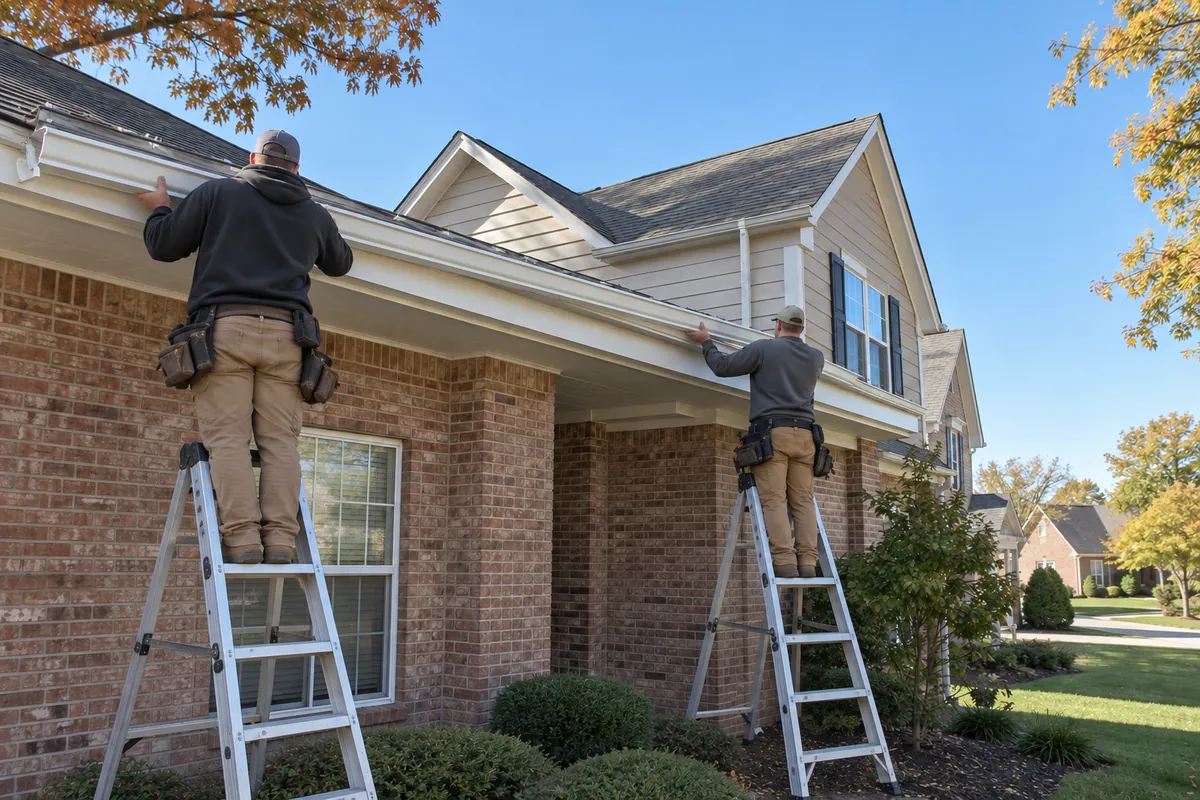
A replacement on a typical Overland Park home is a one-day job. The crew removes the old system, repairs fascia where it's needed, hangs the new runs, sets the downspouts, and hauls the old aluminum away for scrap. On a Blue Valley two-story with 250 feet of gutter and eight downspouts it may run into a second morning. Call (913) 444-6447 for a no-cost replacement quote, or read on for how the sizing decision and the pricing work.

Kansas City sits where Gulf moisture meets Rocky Mountain fronts, and the result is rain that arrives in volume. Overland Park averages just over 40 inches a year against roughly 30 for the country as a whole, but the annual total understates the problem. The National Weather Service's Kansas City office records May as the wettest month at about 5.8 inches across fourteen rainy days, and individual storm events of 2.5 to 4 inches are ordinary enough that local contractors design around them. What matters for a gutter is not how much rain falls in a year but how much falls in ten minutes.
The arithmetic favors the larger profile. A 6-inch K-style gutter carries roughly 40 to 50 percent more water than a 5-inch one, and a 3×4 downspout drains nearly twice what a 2×3 does. On a single-story ranch with four straight runs and a downspout at every corner, a 5-inch system handles a Kansas City storm without complaint. On a two-story with three roof planes feeding one inside corner, the same 5-inch gutter sheets over at that corner before the downspout has a chance to catch up. That overflow lands against the foundation, and the clay soils under most of Johnson County hold water against basement walls rather than letting it drain.
The upgrade costs about $2.75 to $4.75 more per linear foot — roughly 20 percent on aluminum — and it is the single most common recommendation on replacement quotes south of 435. Half-round profiles carry less than K-style at the same nominal size, which is worth knowing on a period home where the look is the point; a 6-inch half-round is roughly equivalent to a 5-inch K-style in capacity. A sizing guide that works through the roof-area math for a specific house is in progress on the guides page.

Johnson County's debris calendar has two seasons, not one, and the trees responsible are on record. K-State Research and Extension's Johnson County office publishes a recommended-trees list for the Kansas City area that reads, in its "not recommended" and "use with caution" sections, like an inventory of what fills local gutters: silver maple for its weak wood and prolific seed, cottonwood for its June fluff, sweetgum for the spiked balls it drops from November into February, and pin oak — the single most common shade tree in 1960s-to-'80s Overland Park subdivisions — for its iron chlorosis and its habit of holding dead leaves through the winter.
Pin oak catkins arrive first, in April and May, as a fine tangle that mats over any gutter opening. Silver and red maple helicopters follow through May. Cottonwood fluff comes in June. Then there is a quiet stretch until the sycamores and early oaks begin dropping in October, and the main event — the pin oak drop — runs from late October well past the first freeze, often into January. A guard that handles one of those seasons and not the other is only half a solution.
The guard types sort out predictably. Micro-mesh — a fine stainless screen over an aluminum frame — stops catkins and helicopters and is the only type that reliably handles the spring season; it costs the most and needs an occasional brushing when pollen and shingle grit build up on the surface. Perforated aluminum covers handle leaves at a lower price but let catkins and small seeds through. Reverse-curve covers shed leaves well and overshoot in the heaviest rain. Foam and brush inserts handle almost nothing after a season and are best avoided. Local installed pricing runs $7 to $10 per foot for perforated and $11 to $14 for micro-mesh; the national franchise products cost considerably more for the same mesh.
Whether guards make sense depends almost entirely on the canopy. Under mature oaks and maples north of 435 or in Prairie Village, where three cleanings a year at $150 to $250 each is the alternative, micro-mesh pays for itself in four to six years. In a young south-side subdivision where the street trees are still fifteen feet tall, a twice-yearly cleaning is the better money. The Johnson County gutter calendar lays out what falls when.

On sectional systems the usual repairs are familiar: resealing seams and end caps with a gutter-grade sealant, replacing spikes with screw-in hidden hangers where the old ones have backed out, re-pitching a run that has gone flat, and reattaching a downspout that a snow slide pulled off the wall. Locally these land between $100 and $550 per visit. On a seamless system the repairs are fewer and mostly at the corners, where a miter that was hand-sealed on the day of installation eventually dries and opens.
The honest threshold is worth stating plainly. A twenty-year-old sectional system with three or more failure points — a leaking miter, a sagging run, and a pulled downspout, say — is a replacement, not a repair, because each fix buys a season and the next seam is already aging. A ten-year-old seamless system with one bad corner is a repair. Contractors who quote both options in writing are doing the homeowner a favor.
Cleaning follows the calendar rather than the season on the calendar. Twice a year covers most of Johnson County: once in late May or early June after the catkins and helicopters finish, and once in December or January after the pin oaks finally let go. Homes under a full canopy need a third pass in late October. Single-story cleaning runs $70 to $200 locally and two-story $120 to $290; the flat-rate national cleaning networks that advertise in Overland Park charge $249 to $399. Two-story cleaning is ladder work at 25 feet over landscaping, which is the main argument for paying someone.

A gutter's job ends at the downspout, and in Johnson County the downspout's job is harder than usual. The county's soils are heavy clays — the Martin and Kennebec series that expand when wet and shrink when dry — and water that lands within a few feet of a foundation tends to stay there. Basement seepage after a May storm is far more often a downspout problem than a foundation problem, and it is a great deal cheaper to fix.
Standard 2×3 downspouts cost $5.50 to $7.50 per foot installed; 3×4 downspouts, which pair with 6-inch gutters and drain nearly twice as fast, run $8 to $10.50. Either should discharge at least four to six feet from the house, onto a splash block or into an extension. Many HOA subdivisions south of 435 and in Olathe require or strongly encourage underground drain lines that carry roof water to the curb or a dry well, and retrofitting one to an older home is a common add-on to a replacement quote.
Fascia and soffit repair runs $18 to $24 per linear foot locally. On north-side homes it is nearly always part of a replacement — a few feet beside each old spike location — and it is worth having quoted up front rather than discovered on the day. Aluminum fascia wrap over sound wood is a durable finish; wrap over rotten wood hides the problem for a couple of years and then fails with the gutter attached to it.

Tudor Revivals in Mission Hills, the colonials of Hallbrook and Mills Farm in Leawood, Prairie Village's better-kept Cape Cods, the 1920s houses along Santa Fe Drive in downtown Overland Park — these are homes where a half-round profile in copper or galvalume is the correct answer rather than an upgrade. K-style aluminum on a Tudor looks like what it is.
Copper runs $14 to $23 per foot in material and roughly $25 to $35 installed in the Kansas City market, develops its brown-to-green patina over five to ten years, and outlasts the roof above it by decades. Half-round copper is joined with soldered seams rather than sealant, which is skilled work and part of the price. Galvalume — a zinc-aluminum coated steel — delivers most of the look at a mid-tier price and takes a natural gray finish rather than a patina. Both carry less water than K-style at the same nominal size, so a 6-inch half-round is the usual specification on a two-story.
Call to discuss copper and half-round options, or see the Leawood page for how estate rooflines change the calculation.

Ten of twelve companies serving Overland Park publish no pricing at all. These are the Kansas City ranges from published 2026 data.
| Service | Low | Typical | High | Unit |
|---|---|---|---|---|
| Seamless aluminum, 5" K-style | $5.90 | $8.50–$10 | $10.40 | per LF installed |
| Seamless aluminum, 6" K-style | $10 | $12 | $14 | per LF installed |
| Vinyl (sectional) | $3.90 | $5 | $6.90 | per LF installed |
| Galvanized steel | $7.40 | ~$10 | ~$14 | per LF (material $7.40–$9.25) |
| Copper | $14 | ~$25 | $35 | per LF (material $14–$23) |
| Gutter guards, perforated aluminum | $7 | $8.50 | $10 | per LF |
| Gutter guards, micro-mesh | $11 | $12.50 | $14 | per LF |
| Downspouts, 2×3 / 3×4 | $5.50 / $8 | — | $7.50 / $10.50 | per LF |
| Cleaning, one story / two story | $70 / $120 | $110–$160 / ~$200 | $200 / $290 | per visit |
| Repair | $100 | ~$250 | $550 | per project |
| Fascia / soffit repair | $18 | $21 | $24 | per LF |
| Tear-off and disposal of old gutters | $2 | — | $3 | per LF |
Sources: Angi Kansas City pricing data (June–August 2026), HomeBlue Overland Park installation estimates, and published Kansas City contractor price sheets. Ranges are for planning, not quotes; Kansas City-area sales tax (about 9 percent) applies to materials.
The widely quoted "$1,064 average" for Kansas City seamless gutters describes a small ranch job with the old system left in a pile, and it sets expectations that a Blue Valley quote will immediately break. A two-story with 220 feet of 6-inch gutter, eight 3×4 downspouts, tear-off, and micro-mesh guards is a $6,000-to-$10,000 project. Copper on a Leawood estate can double that. Many Kansas City contractors offer promotional financing — zero-interest terms of 12 to 18 months are common on work at that scale — and a written quote should say so if it applies.
Three things move a quote more than the material: the number of stories (labor and ladder time), the number of inside and outside corners (each is a hand-sealed miter), and the condition of the fascia. Two quotes on the same house that differ by 30 percent usually differ on one of those, not on the aluminum.
Get a written quoteJohnson County has an unusually crowded gutter market — several of the metro's largest gutter companies are headquartered in Lenexa and Olathe, two national guard franchises sell here, and a dozen roofing and exterior companies quote gutters as a side line. "Guttering," as the local companies tend to call it, is competitive enough that written quotes and same-week estimates are the norm rather than a favor. That is good for homeowners, and it also means the quotes will not be comparable unless the homeowner makes them so.
The useful questions are specific. What gauge is the aluminum — .027 is the residential standard, .032 is heavier and worth the small premium on long runs. What hanger, at what spacing. Is tear-off and disposal included. Is fascia repair quoted per foot or discovered on the day. What does the workmanship warranty actually cover, for how long, and is it separate from the manufacturer's finish warranty. Will the crew be the company's own or a subcontractor. Can the contractor show a recent job in the same neighborhood. A company that answers those in writing on the first visit is usually the one to hire.
Kansas has no statewide contractor license, so the credentials to ask about are the ones that exist: a Kansas roofing registration number if the company also roofs, a Johnson County contractor license class if the work touches structure, and current certificates of general liability and workers' compensation insurance — the latter matters because a crew member who falls from a two-story ladder on an uninsured job becomes the homeowner's problem. The Kansas Attorney General's office issues consumer alerts after every major hail event about unregistered out-of-state crews working door to door; a contractor who arrived uninvited after a storm, wants a signature the same day, or asks to be paid in full before starting is the pattern those alerts describe.
The estimate line on this site reaches independent Johnson County contractors who have agreed to quote in writing and answer those questions. Call (913) 444-6447 to be connected, or read the county page for the contractor rules in more detail.

A contractor measures every run with a wheel or a laser, counts the downspouts and corners, checks fascia condition and pitch from the ladder, notes the tree cover, and quotes in writing — materials by name and gauge, profile and size, color, hanger type and spacing, warranty terms on both workmanship and finish, a timeline, the total price, and the payment schedule. The Kansas Attorney General's consumer guidance for roofing and exterior work says the same thing in plainer words: get all of it on paper before anyone starts, get more than one estimate, and be wary of anyone who wants full payment up front or who arrived at the door uninvited after a storm.
There is no obligation attached to the estimate. Calls to this site's number reach independent Johnson County contractors who quote and perform the work under their own names; how that referral arrangement works, and how it is compensated, is explained on the disclosure page.
On mid-century ranches the original gutter spikes were driven into fascia that has since had seventy winters of wet-dry cycling. The gutter doesn't fail; the wood behind it does. When one spike backs out, the run sags between its neighbors, water stands, and the weight pulls the next spike. Replacement on these homes almost always includes a few feet of fascia beside each old spike, and the difference between a quote that says so and one that doesn't is the difference between a finished job and a change order.
Two-story traditionals with three or four roof valleys push all of that water to one inside miter. When a 5-inch gutter sheets over at that corner in a May storm, the fix is a 6-inch system and a 3×4 downspout at that corner, not a bigger splash block below it. The same homes, now twenty-five to thirty-five years old, are reaching the point where the original hidden hangers have loosened in the fascia and the runs have lost their pitch.
Under a full pin oak and silver maple canopy, gutters fill in April with catkins, again in June with helicopters and cottonwood, and then continuously from late October into January as the oaks let go. The arithmetic on micro-mesh guards changes quickly at three paid cleanings a year, and it is the one part of Johnson County where a guard quote is usually the better long-term money.
One county, eighteen cities, four generations of housing. Gutter needs track the age of the neighborhood more than the city line.

What falls, when it rains, and when to clean — month by month, built from K-State's tree data and NWS rainfall normals.
Read the guide
What hail does to aluminum, how to document it, what insurance typically covers, and how to spot a storm chaser.
Read the guideUsually two things at once. Pin oak catkins have half-filled the gutter by mid-April, and a Kansas City spring cell can drop an inch of rain in twenty minutes. A 5-inch gutter that is 40 percent full of catkins has roughly the capacity of a 3-inch gutter, and the water simply sheets over the front edge. Cleaning after the catkin drop finishes and upsizing to 6-inch on two-story rooflines each solve half the problem; together they solve it.
Policies vary and an adjuster makes the determination, but functional hail damage — crushed drip edges, creased downspouts, guards knocked loose — is commonly covered alongside roof damage from the same storm, while purely cosmetic dimpling often is not. Documenting with dated photos and a coin for scale before any repair is the step most homeowners skip. The hail damage guide walks through it.
Often, yes. Roofers routinely damage older gutters during tear-off, the drip edge is replaced in the same job, and a claim that already covers the roof frequently covers gutters dented in the same event. It is also the cheapest moment to upsize to 6-inch, since the crew is already on the ladder and the fascia is exposed.
Pin oak and red oak catkins drop over roughly three weeks between mid-April and mid-May, depending on how warm March was. Silver maple helicopters follow through May. The practical cleaning window is the last week of May or the first week of June, after both have finished.
Pin oaks are marcescent: they hold dead leaves through the winter and shed them gradually, often into February. In Overland Park neighborhoods planted with pin oaks in the 1960s and '70s, the "fall" cleaning window runs into the new year, which is why one November cleaning so often leaves gutters packed by Christmas.
Aluminum can be installed in any month. Sealants need a few hours above roughly 40°F to cure, so winter installs are scheduled around the forecast rather than the calendar. Most Johnson County contractors work through December and are fully booked again by late February, when hail season is a few weeks off.
No. Ice dams form when heat escaping through the attic melts snow on the roof, which refreezes at the cold eave. Guards sit below that line and neither cause nor prevent it. What does matter is attic insulation and ventilation — the fix for ice dams is upstairs, not on the gutter. Guards can collect a ridge of ice on their surface in a hard freeze, which is cosmetic and clears on the first thaw.
Twenty to thirty years for seamless aluminum with proper hangers and pitch; longer for copper. Kansas City shortens the low end with hail — a system can be functionally fine at fifteen years and still be replaced after one bad May storm. Sectional systems with seams typically start leaking at the miters between ten and fifteen years.
Published Kansas City figures put 5-inch seamless aluminum between $5.90 and $10.40 per linear foot installed, with most written quotes landing between $8.50 and $10. Six-inch runs $10 to $14. Add $2 to $3 per foot for tear-off and disposal of the old system if the quote doesn't include it. The pricing section above has the full table and the whole-house ladder.
Like-for-like, non-structural replacement is generally exempt under the city's adopted building code, so a straightforward gutter replacement typically needs no permit. Work that alters the roof edge, ties into underground drainage, or is part of a larger exterior project can be different. Confirming with Overland Park's building division before a larger job is the safe course.
Kansas has no statewide contractor license. The Kansas Roofing Registration Act, administered by the Attorney General, requires anyone selling roofing services to hold a registration certificate; gutter-only work isn't explicitly named in the Act, but most Johnson County gutter companies also roof and carry a registration number. Johnson County also runs its own contractor licensing program with the cities. Practically, a written contract listing materials, warranty, timeline, price, and payment schedule protects a homeowner more than any single credential.
Six-inch, with 3×4 downspouts, in almost every case. Blue Valley two-stories concentrate large roof areas into a few inside corners, and the 20 percent premium over 5-inch is small next to the cost of water against a foundation. Five-inch remains fine on a single-story ranch with a simple roofline.
One call reaches vetted Johnson County contractors. Written quotes, no obligation.
Talk to a Johnson County Gutter ProCalls answered Mon–Fri, 7 AM–9 PM · (913) 444-6447